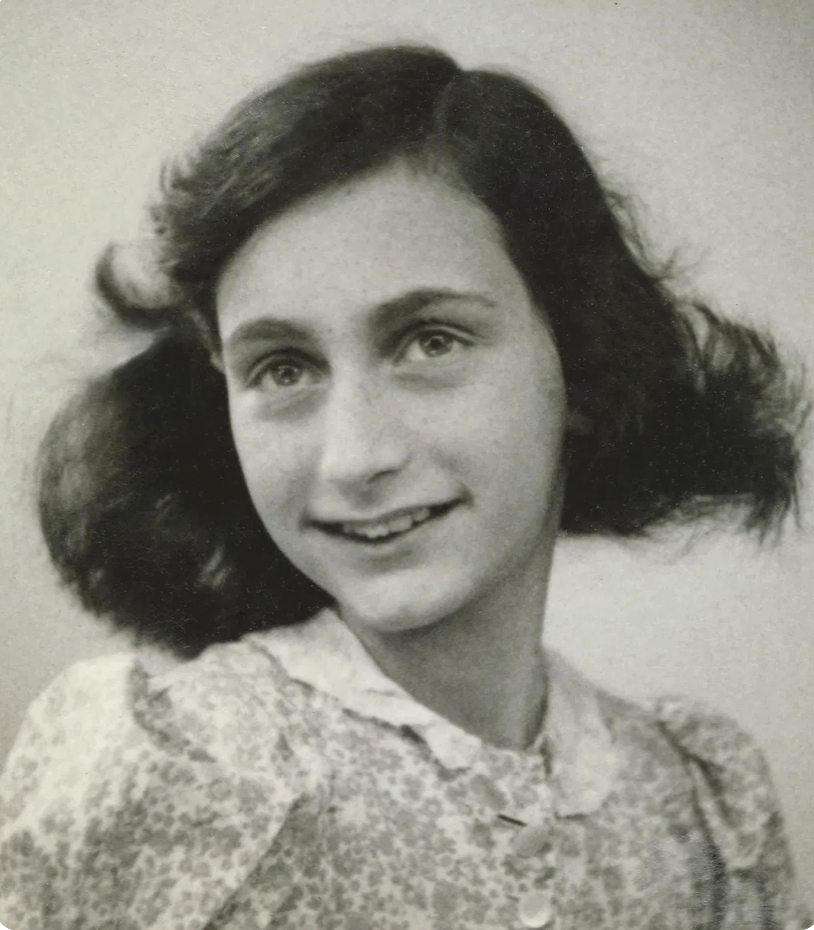
What began with a tree has grown into a broader educational and community initiative. Centered on an Anne Frank sapling planted in Iowa City, the University of Iowa’s Anne Frank Initiative uses Anne Frank’s story and legacy to foster dialogue about history, identity, writing, and belonging.
A presentation at the EV History Center on Sunday, October 25 will explore the history of the Anne Frank tree, Anne Frank’s relationship to it while in hiding, the global sapling program, and the collaborative effort to bring a sapling to Iowa City. Presenters will also discuss how Anne Frank’s enduring legacy as a writer infuses the initiative’s outreach with local schools, where students engage with questions of identity, memory, and self-expression through their own writing. In addition, the session will highlight examples of campus programming inspired by Anne Frank’s life and work, as well as a community historical walking tour that uncovers local histories and invites participants to reflect on the connections between place, memory, and belonging. Together, these efforts demonstrate how Anne Frank’s story continues to inspire learning, dialogue, and civic engagement across generations in Iowa.
The presenters will be: Tamar Bernfeld is an assistant director in the Center for Teaching (CfT) where she works with undergraduate students, graduate students, staff and faculty to support effective teaching at the University of Iowa. Among her projects in the CfT, Tamar leads the Students as Partners program, which pairs undergraduate students with faculty to bring student voice and student perspectives into course design and implementation. At the University of Iowa, Tamar has taught courses in English as a Second Language (ESL), Rhetoric, as well as Approaches to Teaching Writing and Language and Learning in the College of Education. Currently Tamar teaches a First Gen Hawks Seminar and a General Education course, World Englishes, in Linguistics. Her scholarly interests include writing pedagogy and language ideology in educational spaces. Anne Frank’s writing resonates with Tamar, who believes that storytelling is one of the most powerful ways to reach people, connect with our shared human experience, and develop awareness and empathy.
Denise Filios is a scholar of comparative literary and cultural studies whose research focuses on medieval Iberia. She is also an avid hiker whose current research project explores Christian, Jewish, and Islamic ‘medieval’ walking routes in Spain and Portugal, such as the Camino de Santiago, the Ruta del Califato, and Sephardic heritage itineraries. Denise is interested in the intersections between gender, race, religion, sexuality, place of origin, landscapes and belonging, as well as performance, cultures of fitness, memory studies, heritage tourism, foundational myths and national identity. She seeks to promote inclusion in her teaching, scholarship, and service.
Mallory Hellman is the granddaughter of Holocaust survivors. She learned Anne Frank’s story early and engaged with Anne’s diary at several points in her education. Mallory has followed in the educational footsteps of her grandparents. After graduating from Harvard in 2008, she pursued an MFA at the Iowa Writers’ Workshop and has since served as the director of the Iowa Youth Writing Project, providing literacy education and enrichment to marginalized K-12 youth.
Kirsten Kumpf Baele is an Associate Professor of Instruction in German and Director of the Anne Frank Initiative at the University of Iowa. Her teaching, research, and public engagement focus on human experiences, social justice, empathy, and resilience, with particular attention to stories of confinement, displacement, and transformation. Her scholarship spans German literature, film, cultural studies, pedagogy, and memory studies. She is co-editor of Exploring Anne Frank and Difficult Life Stories (2025) and has published on topics ranging from homelessness and spatiality to cultural icons, children’s literature, and service-learning. She is actively engaged in community-based education and public humanities initiatives. Anne Frank’s texts remind her of the importance of listening to young people’s voices and recognizing their agency, even amid profound crisis.
All are invited to attend this event at no charge. Donations are accepted. The English Valleys History Center is at 108 N. Main St., North English, Iowa.

